
Transcranial Magnetic Stimulation (TMS)
Project Description
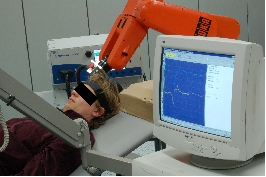
Aim of the project is to develop a robot assistance system for delivering TMS. Furthermore, we work on a statistical brain mapping procedure to localise muscle representations in the cortex.
The advantages of robotised TMS are manifold:
- Precise targeting of stimulation points.
- Precise tangential orientation of the stimulation coil.
- Simple planning and fast probing of grid-like stimulation patterns.
- Motion compensation keeps coil in place even if the patient moves. A fixation of the head is not necessary any more.
- Repeatability.
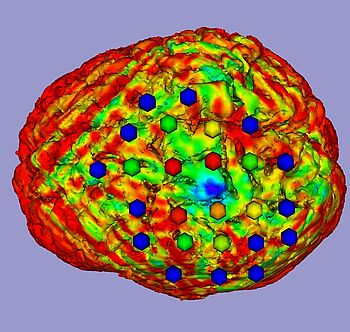
For the brain mapping algorithm we combine all three essential pieces of information: The coil positions for stimulation, the corresponding muscle responses, and the characteristic field of the coil used. The main idea is to assume a monotonic functional relation between the electric field strength at the representation point and the evoked muscle response. Using a refined algorithm for Correlation Ratio and Kendall's rank coefficient TAU, we are able to calculate likelihood maps for the representation of specific muscles.
Publications
2010
Robot-assisted image-guided transcranial magnetic stimulation for somatotopic mapping of the motor cortex: a clinical pilot study, Acta Neurochirurgica , vol. 152, no. 2, pp. 333-343, 2010.
| DOI: | 10.1007/s00701-009-0565-1 |
| File: | s00701-009-0565-1 |
2009
Robotized image-guided transcranial magnetic stimulation, a novel technique for functional brain-mapping, Clinical Neurophysiology , vol. 120, no. 1, pp. e84, 2009.
| DOI: | 10.1016/j.clinph.2008.07.203 |
| File: | j.clinph.2008.07.203 |
Behandlung von chronischem Tinnitus mit roboterunterstützter TMS, Lübeck: GI, 2009. pp. 86;1018-1027.
Anwendung der FaceAPI zur Bewegungskompensation für die robotergestützte Transkranielle Magnetstimulation, 2009.
2008
Brain-Mapping using robotized TMS, Vancouver, British Columbia, Canada , 2008. pp. 3929-3932.
Comparison of functional brain mapping by computer controled roboterized transcranial-magnet-stimulation and functional MRI, Würzburg , 2008.
Brain mapping with Transcranial Magnetic Stimulation using a refined Correlation Ratio and Kendall's tau, Statistics in Medicine , vol. 27, no. 25, pp. 5252-5270, 2008.
| DOI: | 10.1002/sim.3353 |
| File: | sim.3353 |
A robotic assistance system for transcranial magnetic stimulation and its application to motor cortex mapping, 2008.
2007
Spulenpositionierung bei TMS-Behandlungen mit Hilfe von Kraftsensorik, 2007.
2006
Solving the positioning problem in TMS, GMS CURAC , vol. 1, 2006.
Planning and analyzing robotized TMS using virtual reality., Studies in Health Technology and Informatics , vol. 119, pp. 373-378, 2006.
Robotized TMS for motion compensated navigated brain stimulation, Osaka, Japan , 2006.
2005
Brainmapping With TMS Using A Robot Based Protocol And Image Registration Techniques, Berlin: VDI-Verlag, 2005. pp. 23.
- Research
- SonoBox: A Robotic Ultrasound System for Pediatric Forearm Fracture Diagnosis
- Robotics Laboratory (RobLab)
- OLRIM
- MIRANA
- Robotik auf der digitalen Weide
- KRIBL
- Ultrasound Guided Radiation Therapy
- Digitaler Superzwilling: Projekt TWIN-WIN
- - Finished Projects -
- High-Accuracy Head Tracking
- Neurological Modelling
- Modelling of Cardiac Motion
- Motion Compensation in Radiotherapy
- Navigation and Visualisation in Endovascular Aortic Repair (Nav EVAR)
- Autonome Elektrofahrzeuge als urbane Lieferanten
- Goal-based Open ended Autonomous Learning
- Transcranial Electrical Stimulation
- Treatment Planning
- Transcranial Magnetic Stimulation
- Navigation in Liver Surgery
- Stereotactic Micronavigation
- Surgical Microscope
- Interactive C-Arm
- OCT-based Neuro-Imaging
Achim Schweikard

Gebäude 64
,
Raum 94
achim.schweikard(at)uni-luebeck.de
+49 451 31015232
Floris Ernst

Gebäude 64
,
Raum 97
floris.ernst(at)uni-luebeck.de
+49 451 31015200
Ehemalige Projektmitarbeiter
- Dr. Ing. Fernando Gasca
- Dr.-Ing. Lars Richter
- Dr.-Ing. Lars Matthäus