
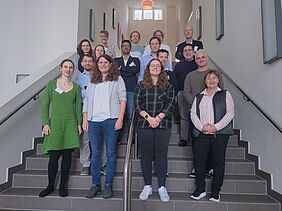
Exoskeletons that support people during rehabilitation after a stroke or severe injury, that assist elderly people and people with motion restrictions in living independently at home and prostheses that allow amputees to regain abilities they need in daily life. These assistive robotic technologies have long been a vision of robotics research. Yet one fundamental challenge remains: to help effectively and safely, an exoskeleton or prosthesis needs to understand the person it is working with. It needs to detect how the user moves, what they intend to do, and when they need support. Wearable sensors, worn with the assistive robotic device or directly on the body, offer a promising way to give the assistive robots these insights. How exactly this can be achieved, and what it will take to bring intelligent robotic assistance into everyday life, was the focus of a three-day expert workshop held in Lübeck from October 13 to 15.
The workshop was funded by the Wübben Stiftung Wissenschaft and organised by Prof. Julia Starke from the Institute of Robotics and Cognitive Systems at the University of Luebeck and Dr. Isabell Wochner from the Hertie Institute for Clinical Brain Research in Tübingen. It brought together thirteen leading researchers from six European countries, representing a deliberately broad range of disciplines: robotics, neuroscience, machine learning, sensing and human-computer interaction.
Rather than following the format of a classic conference with talks and presentations, the workshop was designed as a creative sandpit. The aim was not to present existing results, but to develop genuinely new ideas together. A particular focus was set on interdisciplinarity in order to find ideas that cross borders typically drawn by technical societies and conference venues. Over three days, participants worked in changing small groups, challenged each other’s assumptions and gradually refined initial thoughts into concrete research concepts.
The process was guided by two moderators: Prof. Stephan Sonnenburg, an expert in creativity management and Prof. Elsa Kirchner who contributed a background in assistive exoskeleton research. This combination proved valuable, bringing structured methods for idea generation together with the technical depth to steer the discussion towards concepts which were both innovative and feasible.
The diversity of the group was central to the workshop’s concept. Neuroscientists contributed knowledge of how the human body and brain produce and control movement. An expert in sensing technologies discussed means to measured reliably, comfortably and unobtrusively on the body. Machine learning researchers explored how meaningful information can be extracted from complex sensor data, while specialists in human-computer interaction and social robotics kept the focus on the needs and trust of the people who will ultimately use these assistive robotic systems.
The ideas developed in Lübeck are now being worked out in more detail and will be presented to the scientific community in the coming months through a joint perspective paper. The organizers hope that the new connections formed during the three days will push the field of assistive exoskeletons and prosthetics forward and drive European innovation in the field of assistive robotics.
The organizers thank the Wübben Stiftung Wissenschaft for its generous support, which made this workshop possible, the moderators for their effective and flexible guidance and all participants for their open-minded and enthusiastic contributions.